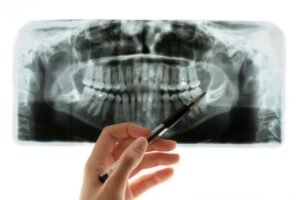
Ideally, all of your teeth should emerge at a right angle from your gumline. This alignment allows them to chew efficiently and support your overall oral health. But sometimes, teeth develop at a sideways angle. This is particularly common among wisdom teeth (the third molars that develop at the back of the mouth). Why do they so often grow in at an odd angle, and what might this mean for your oral health? Continue reading to find out.
Why Do They Grow Sideways?
The reason why wisdom teeth develop sideways is very simple. Often, there is not enough room in the mouth for them to properly emerge from the gumline. These teeth may be forced to fit into any available space at whatever angle is possible, even if that means they are tilted or, in some cases, entirely horizontal. In most instances, these teeth are fully or partially impacted (stuck beneath the gumline).
Problems Caused by Sideways Wisdom Teeth
Sideways wisdom teeth do more than look odd. They can contribute to a number of serious oral health problems, including:
- Pain: Sideways wisdom teeth can push against the nearby molars, leading to discomfort and pain.
- Infection: Partially impacted, angled wisdom teeth can be difficult to keep clean. Food and bacteria may accumulate around them, leading to an increased risk of gum disease and tooth infections.
- Cysts and tumors: Impacted wisdom teeth are associated with an increased risk of cyst and tumor formation. Some cysts are harmless, but others can lead to inflammation pain, and bone damage.
What Can You Do?
If your wisdom teeth are angled or even completely sideways, it is important that you be proactive to prevent them from causing harm. You should:
- See your dentist for routine checkups: Periodic X-rays and exams can determine whether the wisdom teeth are posing a threat to your oral health. Your dentist can recommend timely extractions to prevent any developing issues from getting worse.
- Seek care at the first sign of a problem: Call your dentist or oral surgeon right away if you experience symptoms related to your wisdom teeth, such as pain, bad breath, swelling, or any other unusual signs.
- Be diligent about oral hygiene: Keep partially impacted wisdom teeth clean via thorough brushing and flossing habits. If you cannot easily reach that part of your mouth with floss, try a water flosser instead.
Sideways wisdom teeth can be a big deal! Talk to your oral care team to learn what you should do if your third molars are not properly angled.
Meet the Practice
Under the leadership of Drs. Steve Koo, Thomas Weil, William Shepard, and Talal Beidas, our Houston oral surgery team provides wisdom tooth extractions and a range of other advanced services. If you have questions about your third molars or wish to get them removed, we would be pleased to speak with you. Contact our office at 713-783-5560.